Professional Project · Kahoot!
Kahoot! Coding
Coding Puzzle Game for Kids · Mobile & Web
- My Roles
- Game Designer,
Level Designer, Puzzle Designer - Genre
- Educational coding puzzle, multiplayer
- Platform
- Kahoot! app (iOS, Android) and web
- Audience
- Kids aged 8–14
- Studio
- Kahoot!
Overview
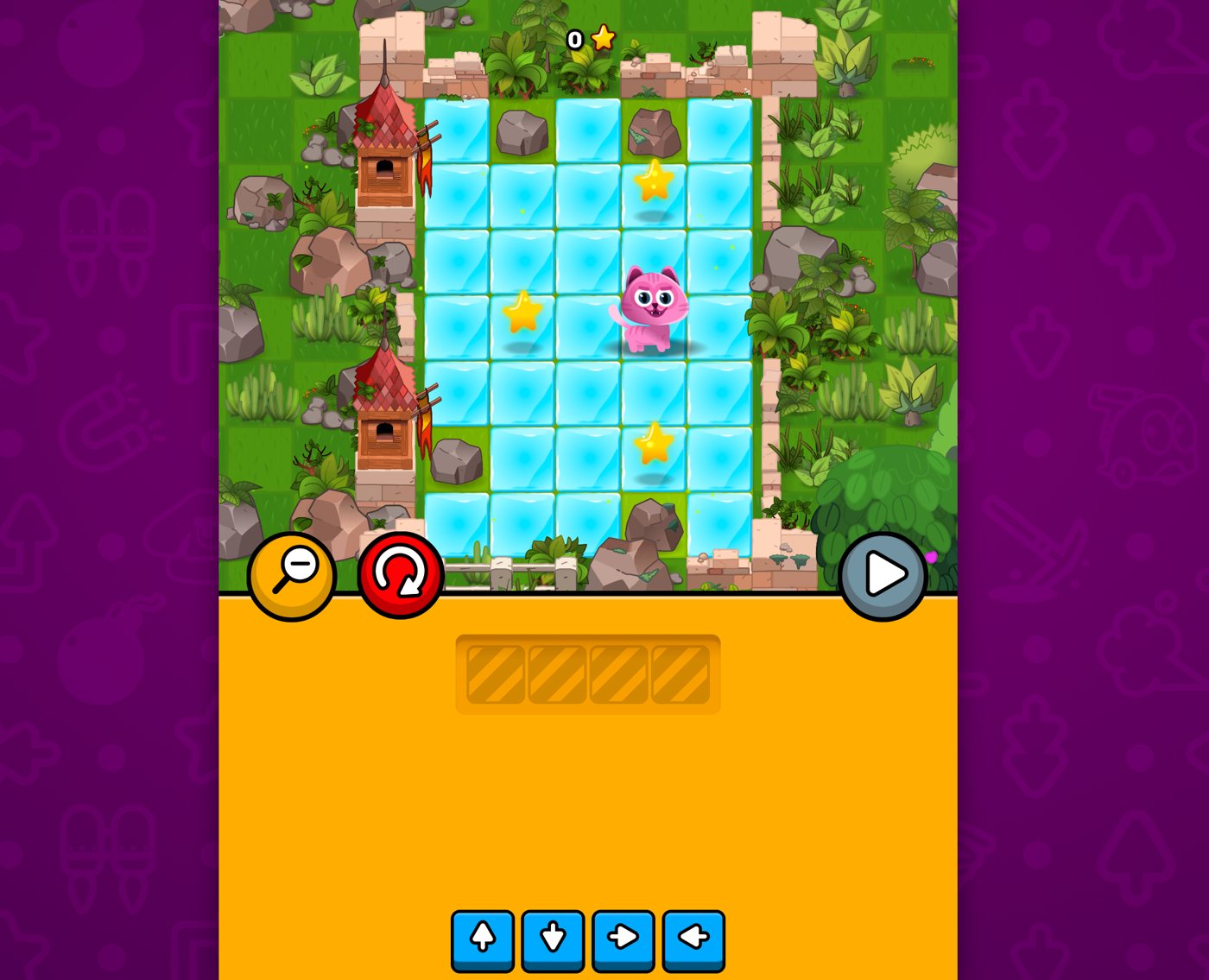
Kahoot! Coding teaches children the basics of programming through play. Kids play a multiplayer game where everyone programs actions and then all are played at the same time. The actions are used to collect stars or damage the opponents. Multiplayer is available locally, but a player alone can play against bots through a fake matchmaking with bots.
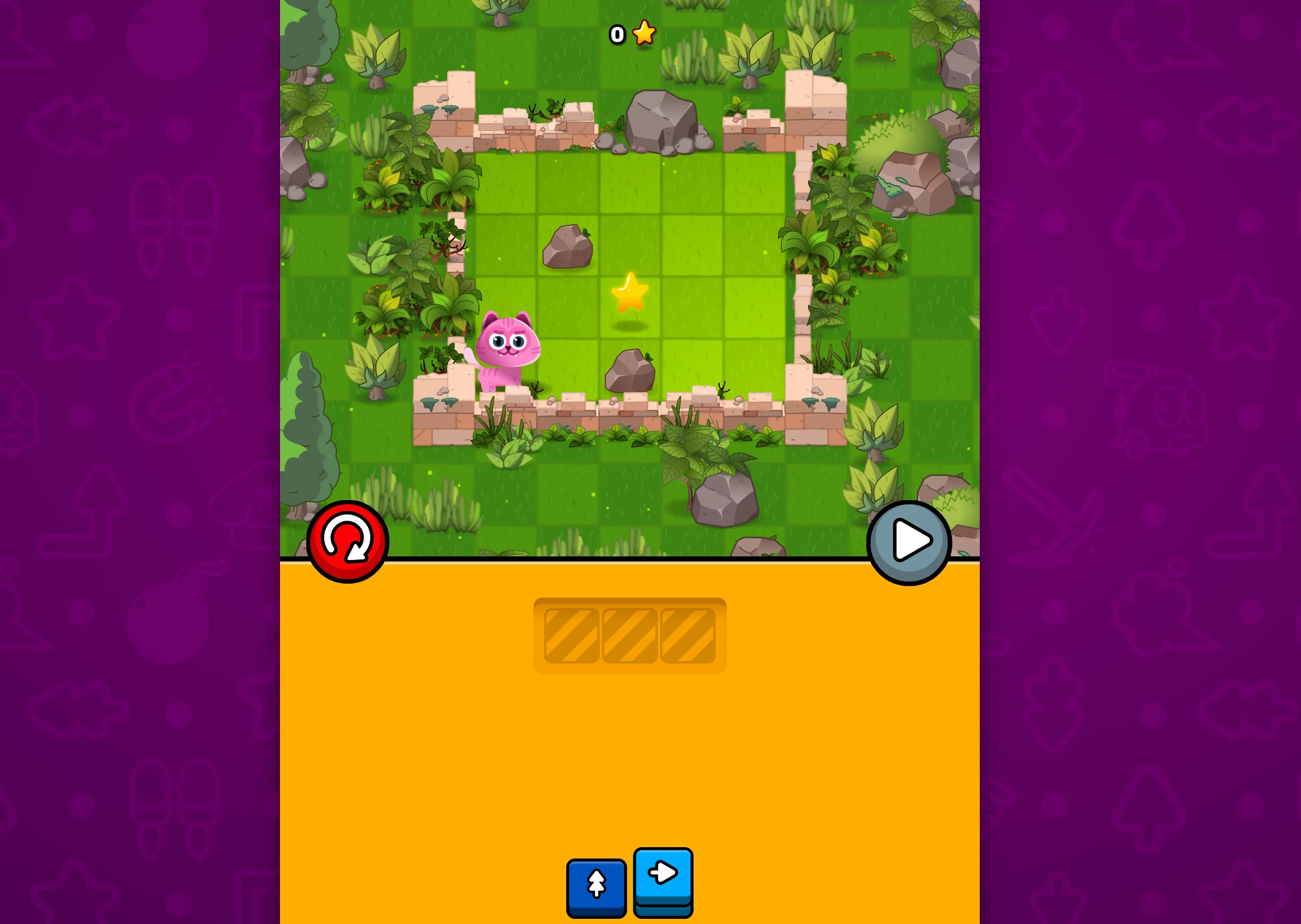
The game also features a solo mode, where they guide a character across a grid by chaining arrow commands and loops, learning sequences, loops and parameters as the puzzles grow more complex. Collectible character cards with abilities add a layer of progression on top of the puzzles.
This game is unique as it features a multiplayer mode, combined with a gameplay that stays true to Dragonbox philosophy: the fun is the learning itself. Although there are rewards, a strong core was built to make sure that the main motivation was the gameplay itself, and that the gameplay would be connected to the learning of the kid.
My Roles
Level Designer
I designed all puzzles in the solo game and all multiplayer arenas. The game constantly changed through development, as we kept iterating on the design. This required constant adaptation of the levels.
Game Designer
I worked closely with the main designer of the project to establish the foundations of the game, the power up system, the multiplayer behaviour. I also designed the characters, assigning them powers to create a unique flavor for each one of them.
Aha Moments for Kids
A strong choice made from the beginning, coherent with Dragonbox DNA, was to have the core of the fun to be the learning itself. The solo experience was not a series of exercises to teach concept after concept. Levels were built with an exciting moment in mind, a discovery that kid has to make. The inspiration came from all sorts of puzzle games, like Portal, Baba is You and Human Resources Machine.
The key here is applying everything we know about puzzle games and the flow state, knowing that for a kid the point of frustration can come much more quickly.
Multiplayer and iterations
In multiplayer, players challenge each other on who is going to have the most stars at the end of a certain number of rounds. As a web game inside Kahoot! platform, Coding didn't have one long term deadline but a constant iteration based on the performance of the game and the analysis of its metrics. We started with a simple local multiplayer, for 2 players, and level selection. By simple I mean making a learning game for kids, multiplayer, with actions played at the same time, a simulation of movement and speed, all coherent with Kahoot! online infrastructure (pin codes, host...). Levels were small, with up to 3 rounds, and game was very much chess-like. To compensate that, we introduced randomness in the instructions players got during a game. This ended up being too frustrating, and, at the same time, we increased the number of players so we had to make levels bigger and longer. I spent a lot of time iterating on the actions, and we introduced some power ups, which were one-shot collectibles on the field like in Mario Kart. Every time we changed something, I had to create completely new levels to adapt to the new design. In the meantime, we carefully checked the metrics and we playtested the game in class.
The biggest change was the introduction of damage. Dealing damage, through a power up, makes a player lose an amount of stars equal to the damage dealt. This was key to allow players that were behind to catch up. Finally, we created a new power up structure: powers are not collectibles, but something assigned to your character and that you get on a certain turn and you can use every turn from that moment on. I did a final iteration of the levels, dividing them into 3 groups, based on their complexity, as to onboard new players on easier ones.
This experience felt like making the best wooden house you can knowing that you are going to invent concrete in 2 months. I am extremely satisfied on how the levels ended up and how the "temporary" fixes I applied in the level design kept the game successful and with enough momentum so that we could continue working on it.
Learn more on the official Kahoot! Coding page.